Talent Insights Report · July 2026

…more than an ATS

UK recruitment trends July 2026: the Jobtrain Talent Insights Report

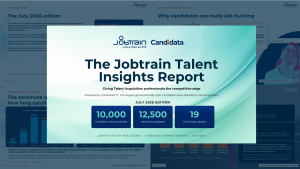
More candidates than ever are searching, and fewer of them are behaving how you might expect. Our July 2026 Talent Insights Report analyses 12,500 real vacancies and 10,010 candidate survey responses to show what is actually driving UK hiring right now, not what employers assume is happening. It is the clearest read available on generational behaviour, offer stage economics and where your best hires are quietly slipping through the funnel.

Download the free report →

12,500

Vacancies
Analysed

10,010

Candidate
Responses

19

Sectors
Covered

4

Generations
Surveyed

Key finding

There are now more 16 to 24 year olds classed as NEET in the UK than there are unfilled vacancies. That is the first time this figure has passed 1.01 million since 2013, set against 712,000 vacancies. Meanwhile only 3.5% of Gen Z say they use AI a lot in their day job, the lowest of any generation, and time to hire has fallen to a five year low of 70.4 days even as application volumes have tripled since 2021.

Where the data comes from

The data comes straight from the Jobtrain platform, which handles hundreds of thousands of vacancies and millions of applications every year. For this edition our Talent Intelligence Unit analysed over 12,500 vacancies across 19 sectors, from January to June 2026.

Alongside the vacancy data we ran the most extensive candidate survey currently conducted in the UK: 10,010 jobseeker responses spanning four generations, from Boomer through to Gen Z. It captures how people search, what convinces them to apply, how they use AI in the process, and what tips the final decision between two offers. The whole picture is powered by Candidata™.

The methodology matters. These are not employer opinions or predictions. They are drawn directly from real ATS activity and real candidate responses, so they reflect what is actually happening in UK hiring right now. The report is published twice a year, which keeps the findings current.

What the data actually says

These are not predictions. They are findings, drawn from 12,500 UK vacancies and 10,010 candidate responses analysed between January and June 2026. Here are the headline numbers.

Findings at a glance: July 2026 vacancy and candidate data

55.4%

Candidates using AI in their job search

52.7%

Convinced to apply by written content

38.7%

Salary as the deciding offer factor

29.9%

Job alerts as top job search influence

23.7%

Gen Z persuaded to apply by video

22.0%

Training and development as offer factor

21.4%

Hires made through internal mobility

70.4

Average days to hire, a five year low

4.8%

Use AI a lot at work (Gen Z: 3.5%)

The pattern behind the numbers

More applicants does not mean more predictable hires. Behaviour is generationally split, offer stage decisions are shifting, and AI is quietly changing how candidates research you long before they apply.

Get the full report, free
All the headline findings, sector by sector data, generational breakdowns, and ten specific actions to take this quarter.
Download now →

Some July 2026 recruitment statistics at a glance

Gen Z long-term commitment sits at 66.5%, against 77 to 80% for older generations. The clearest generational break in the whole dataset, and a retention challenge that will define workforce planning through the next hiring cycle.

Salary is the deciding factor in 38.7% of close-run offer decisions. Training and development (22.0%) and flexible working (21.8%) are effectively tied for second. If your job ads bury pay, you are losing candidates before the conversation starts.

Job alerts beat job board search as the number one job search influence, at 29.9%. A buried or clunky candidate sign up form is a missed channel, not a minor detail on your careers site.

Only 3.5% of Gen Z use AI a lot at work, the lowest of any generation. The digital native assumption is wrong. It is worth asking your own new starters how they actually use AI, rather than assuming.

Agency hires have fallen from 8.1% to 2.3% since 2021. Internal hires have risen from 12.8% to 21.4%. UK employers are recruiting agencies less and promoting more, and the shift shows no sign of reversing.


Download free

The July 2026 Talent Insights Report

Enter your details below and we’ll send the full report straight to your inbox.

Frequently asked questions

What does the July 2026 Jobtrain Talent Insights Report cover?

The July 2026 report analyses 12,500 vacancies across 19 sectors and 10,010 jobseeker survey responses spanning four generations. It covers UK recruitment trends, generational candidate behaviour, AI use in job search, sourcing channel performance, offer stage decision drivers, DEI outcomes and time to hire, giving TA leaders both the data and the practical actions to respond to a shifting labour market.

What are the biggest UK recruitment trends in July 2026?

Our July 2026 data points to five defining trends. Gen Z long-term commitment has fallen to 66.5%, well below the 77 to 80% seen in older generations. AI is now used by 55.4% of candidates in their job search, mostly for researching employers rather than writing applications. Job alerts have overtaken job board search as the number one job search influence at 29.9%. Time to hire has fallen to 70.4 days, a five year low, even as application volumes have tripled since 2021. And internal mobility now accounts for 21.4% of hires, up from 12.8% in 2021.

How are candidates using AI in their job search in 2026?

55.4% of candidates use AI for at least one job search task. The most common use is researching the job or the employer, at 35%. Writing applications comes a distant second at 14%. The bigger story is not AI-written applications but AI-powered employer research, which means your careers site content is under quiet inspection long before a candidate ever hits apply.

What do candidates actually want from employers in 2026?

Salary is the deciding factor in 38.7% of close-run offer decisions, with training and development (22.0%) and flexible working (21.8%) effectively tied for second. But the decision is not the same across generations, and drop off rates at offer stage vary wildly by sector, from a 5.1% average to 30.5% in Manufacturing. The full report breaks these down generationally and by sector.

Which sourcing channels drive the most influence in the UK?

Job alerts and direct messages are the number one influence on a candidate’s job search at 29.9%, ahead of job board search (24.8%) and general web search (18.8%). Written content about the role and employer convinces 52.7% of candidates to apply, against 18.5% for video, but Gen Z candidates are almost twice as likely as Boomers to be influenced by video (23.7% versus 12.5%).

How is this report different from other UK recruitment reports?

Most market reports rely on employer surveys or publicly available labour market data. The Jobtrain Talent Insights Report is powered by Candidata™ and draws directly from ATS performance data (12,500 live vacancies processed through our platform) combined with the most extensive candidate survey currently conducted in the UK. Every candidate finding can be cut generationally. The report is published twice a year, so the findings reflect what is actually happening in hiring right now, not what employers believe or predict.

About Jobtrain

We’re a UK-based applicant tracking system trusted by 200+ organisations, with over 25 years of experience in recruitment technology. We facilitated this research because we believe the talent acquisition community benefits from honest, practitioner-led data.

See how Jobtrain addresses these challenges →

About Jobtrain’s Talent Intelligence

Talent Intelligence is using information and expertise to drive clarity into seeing and addressing talent problems and challenges. Jobtrain is unique in providing a data engine (Candidata™) and a talent insights function headed up by our Talent Intelligence Director, Gary Towers. Our goal is to provide Talent Acquisition and HR functions with business intelligence and insights that will allow you to achieve your goals.